
Writing SEO Content with AI: My Seven-Step Process

“Write me an SEO text about topic X.” Start like that and you’ll get a text that could sit on any website. It reads smoothly, the keyword is in there, and it says nothing that ten other pages haven’t already said.
The difference between an average AI text and one that actually gets found and read is mostly in the preparation and in a human checking the quality.
I’ve been creating and optimising content for more than ten years. Since systems like ChatGPT and Claude became good enough to write drafts to work with, I’ve rebuilt my process step by step. What came out of it are seven steps I’m sharing with you in this article.
I built the process with Claude and SE Ranking. It works just as well with ChatGPT, Gemini or any other system, and with other SEO tools.
Where AI can help with Content, and where not
AI is strong at structuring, rephrasing and brainstorming ideas. It turns an outline into a full draft in minutes, it suggests headlines, it sticks to a defined tone of voice, and it never forgets a keyword from the list.
But it doesn’t know which questions your clients ask in every first meeting. It can’t judge whether a number it comes up with is actually correct. And it has no opinion and no personal experience that it can include in the text.
That division of the different tasks of SEO content creation is the core of the process. AI helps you produce content faster and takes individual tasks off your plate. You provide the facts and the experience, and you check every step to ensure it is good quality.
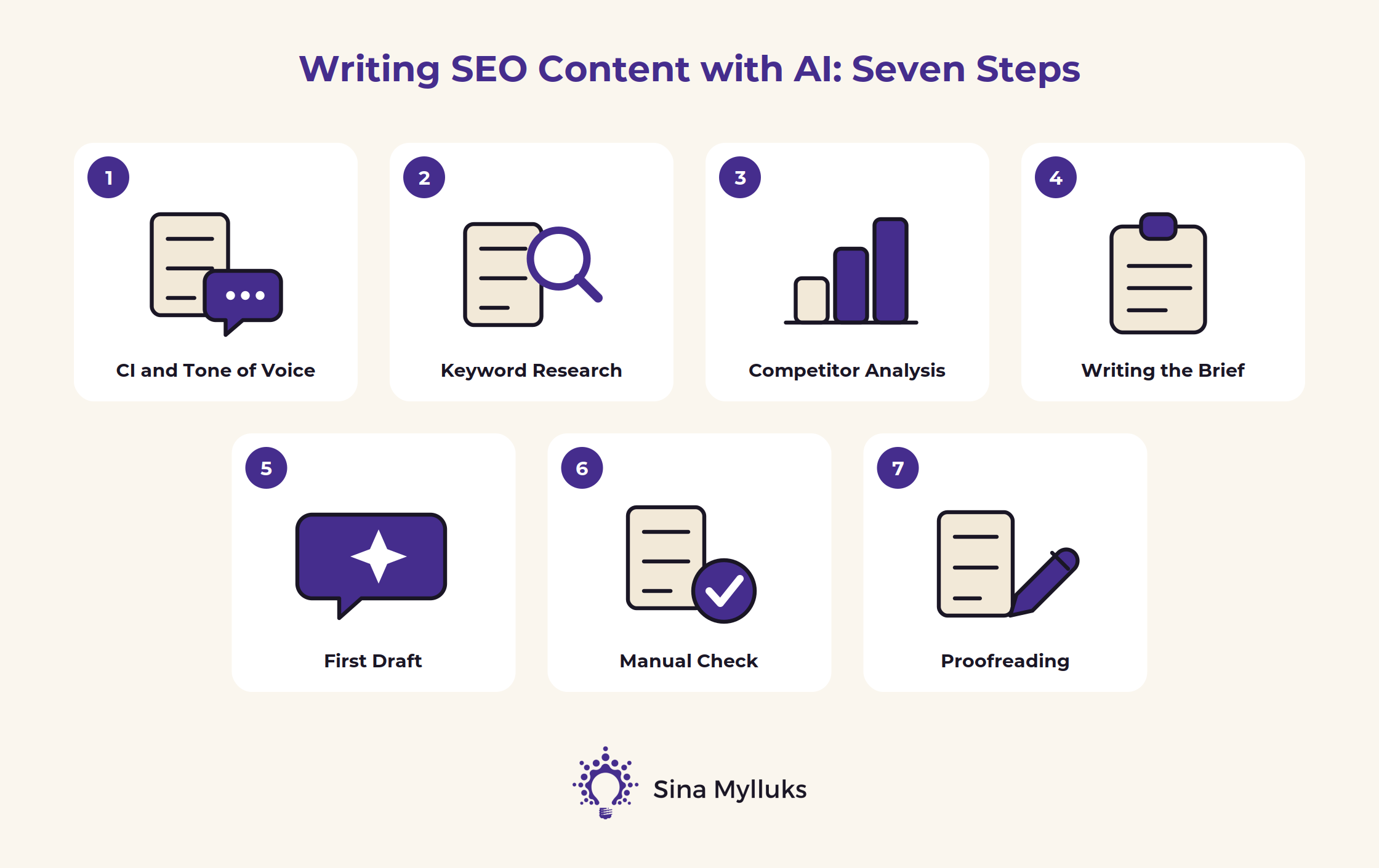
Step 1: Capture Your CI and Tone of Voice
The first document I create has nothing to do with SEO. It describes how your company sounds. Often these guidelines already exist somewhere internally, and you just need to pull them together.
If they don’t, you can create this document with AI. Collect the URLs of a few blog posts, product pages or reports that represent your company’s tone of voice well. Have them analysed and turned into a first draft of a CI and tone of voice document.
Then you add the rules that matter to you but aren’t in the document yet. Mine says, for example, that dashes shouldn’t be used and that sentence lengths should vary. It also includes a list of the words that are off limits.
The first draft won’t be perfect, and it doesn’t need to be. I add to the document whenever I spot something in a text that I’d never write that way.
Step 2: Research and Refine Your Keyword Set
Before the first sentence is written, it needs to be clear what the text is optimised for. I don’t hand keyword research over to AI completely. Claude is very useful, though, for generating initial ideas or extending an existing keyword list.
I’ve connected Claude to my SEO tool SE Ranking and use it as a sparring partner to refine my keyword set and speed up what’s otherwise a very manual process.
Step 3: Create a Competitor Analysis with AI
A competitor analysis is a great starting point for new content and for content you’re updating. It shows you which terms and topics the competitors talked about for a specific topic. Creating this type of analysis used to take hours of manual work. With AI it takes a fraction of that time.
Have the first five to ten organic results for your main keyword analysed fully. I always ask for the same output:
- which terms appear on how many of the analysed pages, and where they appear: in the title, in the H1 or only in the body text
- which formats the top results use, for example a step-by-step guide, a tool comparison or a service page
- which topics everyone covers and which are missing
Step 4: Write a Brief and Enrich It with Your Own Knowledge
In the brief, you bring together all the documents and information you have: CI and tone of voice, keyword set and competitor analysis. You also add everything your AI system can’t know. That might be data from your own studies, experience with a product, or first-hand insights that matter for the topic. The more unique content you can provide, the better.
Step 5: Have the Text Drafted, and Think About Graphics
Only now does the actual writing begin. Give Claude all the documents you’ve prepared and ask it to write the first draft.
If you have a CI document for infographics as well, you can ask for suggestions for graphics at the same time.
Step 6: Check, Correct and Add to the Draft Manually
This is the step you mustn’t skip. The draft you get is a draft, not a finished text.
I go through these questions for every article:
- Is every piece of information factually correct? I check numbers, dates and tool names one by one, even when they sound plausible.
- Are sources cited and linked? External references are a trust signal for readers and bots.
- Does the wording sound like your company? If you stumble over a sentence because you’d never say it that way, rewrite it.
- Are there paragraphs or pieces of information that need adding?
- Have all keywords been worked into the text naturally?
Step 7: Have the Text Proofread
Proofreading is another place where AI saves you a lot of time. Once you’re happy with your text, have it checked once more for spelling, grammar and typos. Usually there are still a few mistakes that you have missed.
What matters here is that you’ve either set up a dedicated skill for this or you say very specifically what should be checked. Otherwise you may get alternative phrasing suggestions and other suggestions you haven’t asked for.
Turn the Process into a Skill
Once you are happy with the workflow, it’s worth capturing for future reuse. I have the individual steps turned into a skill or a small plugin that makes it reusable. You can simply ask Claude in your chat to create a skill based on the conversation. After that you run it via /name-of-the-skill.
The effect shows from the second text onwards. Instead of explaining the tone of voice and the checks from scratch every time, the process starts in the right place straight away. For recurring formats like blog articles, category pages or service pages, that saves most of the setup time.
Creating Content with AI: My Conclusion
The biggest misconception about AI content is that the time is saved during the writing. It’s saved elsewhere: in the analysis, in the structuring and in the proofreading.
The work that remains is providing unique information and checking the quality of the output the LLM creates. You decide what gets said, which examples belong in the text and which information you want to include in the text.
Frequently Asked Questions About Writing SEO Content with AI
No. Google judges content by whether it helps users, not by whether a human or a model wrote it. That’s what its guide on helpful content says.
What does get penalised is something else: content produced at scale to feed search engines without giving readers any useful and relevant information. The fact that such texts are often AI-generated is a correlation, not the cause.
That depends entirely on the groundwork. With a good brief, a tone of voice document and a competitor analysis, the effort comes down to fact-checking and fine-tuning. Without those foundations, you end up rewriting the text almost from scratch anyway.
AI is very helpful for clustering and structuring keywords. For search volumes and current rankings, you should connect an SEO tool via an MCP so the AI can access that data directly.
For the text itself, an AI system such as ChatGPT or Claude is enough. For reliable data on keywords, search results and competitors, you need an SEO tool. The combination is ideal, because many tools can be connected directly via an MCP.
Yes, as long as it meets the same requirements that apply for Google: clear structure, direct answers to concrete questions, verified facts and sources. Content without substance of its own gets cited in AI answers just as rarely as it ranks in Google.

Need Support?
The first call takes about 30 minutes and it’s completely free. Tell me about your project and we’ll work out together how I can help.